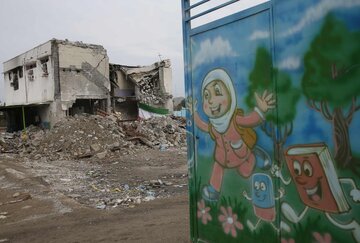

AhlulBayt News Agency (ABNA): Four months after residents returned to the town of "Western Zawtar" in southern Lebanon, the basic necessities of life in this area have still not been provided. The crisis of water and electricity supply has intensified and prevented the resettlement of returning families; a situation that confronts their ability to stay in the village with new challenges every day. Out of a total of about 550 families living in this town, only 150 families have returned. About 50 percent of the residential units have been completely destroyed, and the remaining houses have either suffered minor damage or are no longer habitable.
A Basic Life in the Shadow of No Water and Electricity
Abdul Izz al-Din, the mayor of Western Zawtar, tells the Al-Akhbar newspaper: Families in the town are, in the true sense of the word, living a basic and primitive life. Since their return, residents have relied on water tankers provided by the municipality with the help of civil defense forces and the Lebanese army. They also live without electricity and use battery-powered lamps for lighting.
Izz al-Din adds that since the residents' return, the town has been targeted about five times by attacks in which bursts of gunfire were directed at the public square. Most of this gunfire has hit homes. In addition, the eastern part of the town is still occupied by Zionist soldiers, and the homes in this area have also been targeted by explosions.
The Electricity Grid; Incomplete Reconstruction After Four Months
The mayor of Western Zawtar explains about the electricity situation that airstrikes have damaged the solar energy systems used by homes, and most of the cables have been cut. The electricity distribution networks have also been damaged. For this reason, the municipality has begun the work of reinstalling power poles, laying cables, and providing transformers, but these measures have not yet been completed.
According to Izz al-Din, the needs of the town of Western Zawtar are not limited to rebuilding the electricity grid but also include providing street and alley lights with solar energy. Because during the past four months, there has been no regular and stable source of electricity in the town.
The Water Crisis; The Main Well No Longer Meets the Residents' Needs
The water crisis is more complicated; because the army of the Israeli regime has destroyed the mouth of the main well of the town of Western Zawtar through excavation and demolition operations. This well, even after repair with the help of the head of the union of municipalities of Shaqif, is no longer able to meet the needs of the returning families. The water supply networks connected to the homes have also been damaged and cut off, and parts of them have still not been repaired.
Izz al-Din stresses that the town of Western Zawtar now urgently needs the drilling of another artesian well. Especially since the return of more families will increase pressure on the existing water source.
The Destruction of Underground Networks and the Difficulty of Identifying Damage
Hilal Shaqir, an employee of the "Water of South Lebanon" institution, explains that the well, which was drilled in the 1990s, was considered the main source of water supply for the town. But the army of the Israeli regime has destroyed it through excavation operations. The main water transmission line that fed the internal networks and delivered water to all neighborhoods has suffered the same fate.
According to Shaqir, the damage is not limited to these cases. The explosions and destruction have changed the appearance of the town of Western Zawtar and have cut the networks buried underground. An issue that has made identifying the routes of these networks and the exact location of their damage very difficult.
Shaqir says that 11 rigars in the town of Western Zawtar have been destroyed, and the cost of rebuilding each one reaches $400. Also, the solar energy system for operating the water well, which consisted of 460 panels, has been damaged. So that 180 panels have been put out of service due to shrapnel from the bombardment.
In the absence of government electricity, the only remaining way to operate the well is to use a power generator that consumes about 40 liters of diesel per hour. The cost of this amount of fuel reaches about $60. Despite this cost, there is still no guarantee that water will reach all subscribers, because the available water volume is limited.
A Meager Water Quota; Only Enough for a Few Days of Household Consumption
In a situation where the available resources do not meet the needs of the town of Western Zawtar, the Water of South Lebanon institution provides only about one thousand liters of water to this town once every 15 to 20 days. This amount is distributed among the houses and is barely enough to meet the needs of one household for more than six days.
The crisis becomes more severe when access to the main water supply network of three neighborhoods is also not possible. Because this network is located in an occupied area. This area, called the "reservoir area," is located on the border between the two towns of Western Zawtar and Eastern Zawtar, and the army of the Israeli regime is stationed there. In addition, other networks have suffered numerous and intertwined damages due to the bombardment.
Therefore, water distribution is still carried out with civil defense tankers, and families are also forced to pay the cost of providing their additional water needs.
The Revenue Crisis of the Water Institution; Uncollected Dues from 150 Villages
Shaqir considers part of the financial problems of the Water of South Lebanon institution to be caused by the inability to collect water subscription fees from more than 150 towns. Towns whose residents have either not yet returned to them or which are located in occupied areas.
According to him, this issue has affected the institution's ability to cover the costs of repair, maintenance, and operation of water facilities in towns whose residents have returned.
**************
End/ 345E